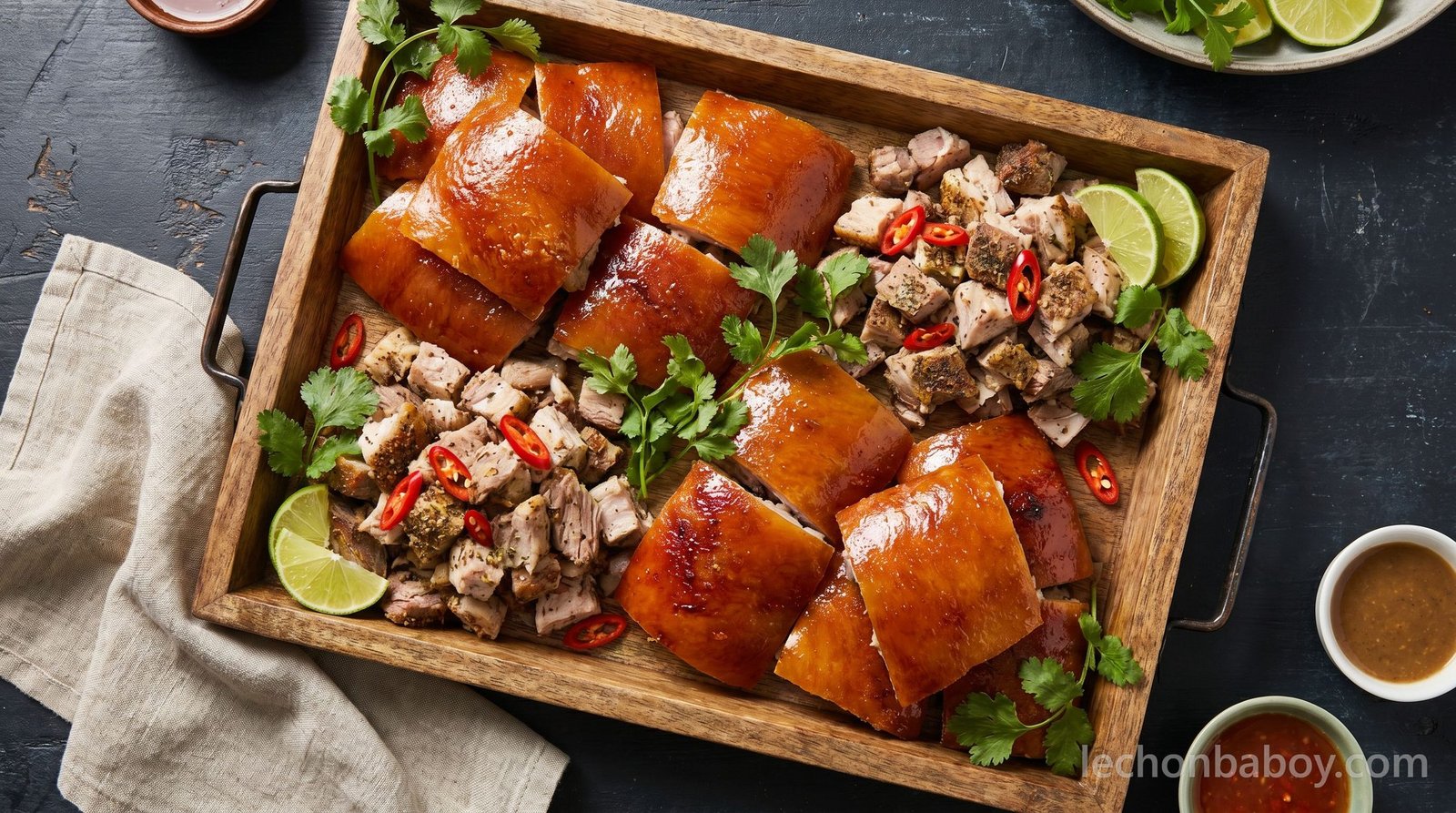
The everyday rule of thumb: plan for about 200–350g of cooked lechon per person. Use the lower end when lechon is one of several dishes, the higher end when it's the star and people will go back for seconds.
Size by headcount
Whole-lechon sizes track cooked weight, which is roughly under half the live weight. Here's the usual mapping for Metro Manila:
| Size | Live weight | Cooked weight | Good for |
|---|---|---|---|
| Small | ~9–12 kg | ~4–5.5 kg | up to ~10 |
| Regular | ~13–16 kg | ~6–7.5 kg | ~10–20 |
| Medium | ~17–20 kg | ~8–9.5 kg | ~20–30 |
| Large | ~21–25 kg | ~10–11.5 kg | ~30–40 |
| Jumbo | ~26–30 kg | ~12–14 kg | ~40–50 |
For an exact recommendation tuned to your party, plug your numbers into the size calculator — it factors in whether lechon is the main or a side, how hungry the crowd is, and whether you want leftovers.
Three things that change the math
Is it the main dish or a side?
If lechon is the centerpiece, lean to ~300–350g a head. If it shares the table with pancit, rice, and other ulam, ~200–250g is plenty.
Who's eating?
A crowd of hungry adults eats very differently from a mixed group with kids and lighter eaters. Adjust up or down accordingly.
Do you want leftovers?
Lechon leftovers are a feature, not a problem — they become paksiw, sisig, and more. If you want some to send home, size up a notch.
Lechon live weight vs cooked weight
Live weight vs cooked weight. Sellers may quote either. Cooked weight is what lands on the table — usually a bit under half the live weight — so always confirm which one a price refers to.